
An appraisal waiver, now officially called Value Acceptance, is a system-generated offer that lets an eligible loan close without a traditional in-person appraisal. Fannie Mae’s Desktop Underwriter (DU) decides this, not you or your lender, so you can’t request one outright. The main upside: you skip an appraisal fee and shave time off closing. The main downside: nobody independently verifies the value or the property’s condition.
Before you go further, do this:
- Ask your loan officer whether DU returned a Value Acceptance offer on your specific loan casefile.
- If it did, ask which version (full waiver or Value Acceptance + Property Data).
- Confirm your lender plans to actually exercise it. They don’t have to.
Key Takeaways
Appraisal waivers save time and money on well-documented transactions but shift valuation risk onto the borrower when the underlying data is thin.
| Point | Details |
|---|---|
| System decides, not you | DU generates Value Acceptance offers automatically; borrowers cannot request one directly. |
| Four-month expiration | The offer must be exercised within four months of the DU run, and ordering an appraisal voids it. |
| Refinances qualify more often | Strong payment history and existing appraisal data make refinance waivers more common than purchase waivers. |
| Savings add up | Fannie Mae estimates over $2.1 billion in borrower savings from Value Acceptance between 2020 and 2022. |
| Condition and value risk remain | A waiver skips independent verification, so unusual or hard-to-comp properties still deserve a full appraisal. |
Table of Contents
- How Appraisal Waivers Actually Work
- Who Typically Qualifies for a Waiver
- What You Actually Save With a Waiver
- Where the Risk Actually Sits
- Should You Accept the Waiver or Ask for an Appraisal?
- How a Waiver Affects Your Equity and Resale Down the Road
- Two Scenarios That Show How This Plays Out
- How We Approach Appraisal Waivers With Clients
- Frequently Asked Questions
- Sources
How Appraisal Waivers Actually Work
DU pulls from Fannie Mae’s appraisal database, which holds millions of past appraisal records, and cross-checks your property against Collateral Underwriter (CU), Fannie Mae’s risk-scoring engine for property values. When your loan casefile matches enough prior data with low variance, DU returns a Value Acceptance message instead of a standard appraisal requirement.
There are two versions worth knowing:
- Full Value Acceptance. No appraisal, no inspection. DU trusts the existing data enough to skip property review entirely.
- Value Acceptance + Property Data. A trained data collector still visits the home, photographs it, and logs measurements through Fannie Mae’s Property Data API. It’s not a full appraisal, but it’s not nothing either.
Here’s the part borrowers miss: the offer expires. Fannie Mae’s rules cap it at four months from the DU run date to the note date, and if anyone orders an appraisal after the offer appears, the waiver is dead for that loan. There’s no going back once an appraisal enters the file. Lenders can also decline to use an available waiver when mortgage insurers require an appraisal, when local law demands one, or when the property has features DU’s data can’t account for.
Who Typically Qualifies for a Waiver
DU favors loans it can verify with confidence. A few signals tend to push a casefile toward acceptance:
- A prior appraisal already on file with Fannie Mae from a recent transaction.
- A neighborhood with plenty of recent, comparable sales.
- Low loan-to-value (LTV) on a refinance, paired with a clean payment history.
- A strong overall credit and income profile.
Plenty of scenarios get excluded automatically. Two-to-four unit properties, co-ops, manufactured homes, transactions involving gifts of equity, and properties valued at $1,000,000 or more generally don’t qualify. Texas Section 50(a)(6) cash-out refinances are excluded by law, and manually underwritten loans never get a DU-generated offer at all. Rural properties, architecturally unusual homes, or houses with recent major renovations also tend to get passed over, simply because DU doesn’t have enough comparable data to trust. That said, Fannie Mae permits higher LTV thresholds for certain high-needs rural areas where appraiser availability is limited. As a general pattern, refinances see waivers far more often than purchases, since existing appraisal history and payment records give DU more to work with.
What You Actually Save With a Waiver
The appeal is straightforward: money and time. Appraisal fees typically run a few hundred dollars, and skipping one removes an entire scheduling step from underwriting. No waiting for an appraiser’s availability, no waiting for the report to come back, no risk of a delayed closing because someone couldn’t get on-site.
Fannie Mae estimates Value Acceptance saved borrowers more than $2.1 billion between 2020 and 2022, a scale that reflects how many refinances and purchases now qualify. The advantage shows up most clearly on:
- Simple rate-and-term refinances with strong existing equity.
- Low-risk purchase transactions in well-documented neighborhoods.
- Any deal where a tight closing timeline matters to you or the seller.
Where the Risk Actually Sits
A waiver doesn’t mean the value is right. It means DU’s data model is comfortable enough with the risk to skip verification, which is a different thing entirely. Automated models can misjudge a property, and buyers who accept a waiver on a mispriced home can end up overpaying with no independent check to catch it.
There’s also the condition question. An appraiser’s job includes noting deferred maintenance, safety issues, and red flags a buyer might miss during a walkthrough. Skip the appraisal and you skip that second set of eyes, too, which is exactly why a waiver is never a substitute for a home inspection. If your finances or the market shift later, a lower future appraisal on a refinance or sale can catch you by surprise, since nothing confirmed the original number independently.
- Overvaluation risk sits entirely with you, not the lender.
- Property condition issues can go unnoticed until they’re expensive.
- Once an appraisal is ordered, the waiver is gone for good.
Pro Tip: If you have any doubt about a property’s true condition, order the appraisal anyway. A few hundred dollars is cheap insurance against a valuation problem that surfaces at resale.
Should You Accept the Waiver or Ask for an Appraisal?
Start with these questions for your lender:
- Did DU return a Value Acceptance message on this loan casefile, and which version?
- Will you actually exercise it, or does your investor or MI provider require an appraisal regardless?
- Can you show me the DU Findings report language confirming eligibility?
From there, a few decision rules help. Insist on a full appraisal if the home has unusual architecture, visible condition issues, thin comparable sales data, or a purchase price that feels aggressive against nearby sales. A purchase contract’s appraisal contingency still protects you independently of whatever the lender’s system decides, so keep it in place unless you’re fully confident in the price. For refinances, a long, clean payment history and stable home value usually make the waiver a reasonable call. If you’re weighing whether refinancing makes sense at all right now, running the numbers through a refinance calculator first tells you more than the appraisal decision ever will.
How a Waiver Affects Your Equity and Resale Down the Road
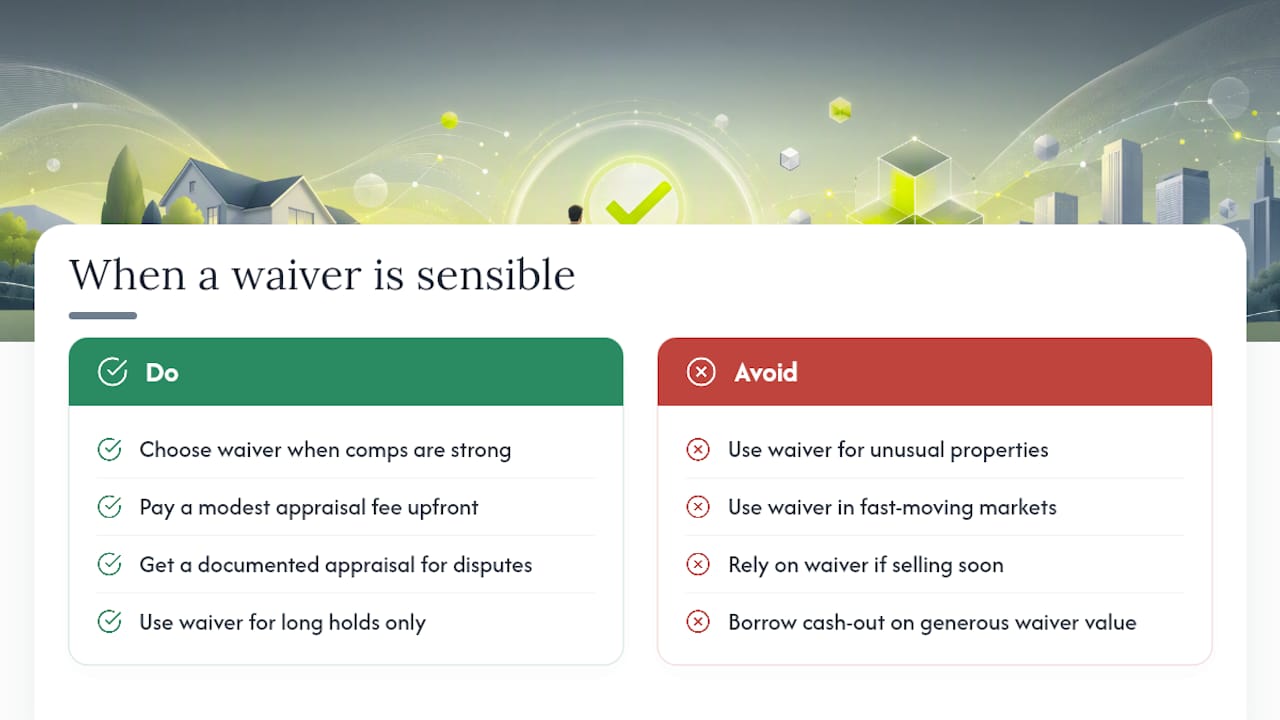
A waiver locks in a value at closing, but that number came from a model, not a walkthrough. If the automated estimate ran high, your actual equity position at closing may be thinner than your paperwork suggests. That gap doesn’t usually matter if home values keep rising and you hold the property for years. It matters a lot if you need to sell or refinance within a year or two and the market has softened.
Resale is where this gets tested. A buyer’s independent appraiser, working off a fresh set of comps, might land somewhere different from the number your waiver-based purchase used. If your original value skewed optimistic, that gap can surface as a lower appraisal on the sale side, which can slow a deal or force a price renegotiation. On a cash-out refinance, the same logic applies in reverse: if DU’s data supported a value that turns out to be generous, you could be borrowing against equity that isn’t fully there.
None of this means waivers are dangerous by default. Most are issued on transactions with strong comparable data precisely because the risk of a bad number is low. The exposure grows when the property is unusual, the market is moving fast in either direction, or you’re planning a short holding period. In those cases, a modest appraisal fee upfront is cheaper than an equity surprise later, and it gives you a documented value you can point to if a future lender or buyer disputes it.
Two Scenarios That Show How This Plays Out
Consider a homeowner refinancing a 30-year fixed mortgage after five years of on-time payments. Their loan-to-value has dropped, home values in the neighborhood have climbed steadily, and Fannie Mae already has appraisal data from the original purchase. DU returns a full Value Acceptance offer. There’s little reason to push back here. The comps are consistent, the payment history is clean, and ordering an appraisal would just add cost and delay to a transaction that’s already low risk.
Now compare that to a buyer purchasing a converted barn home on five acres, competing against two other offers. Even if DU somehow returned a waiver, this is a property where comparable sales data is thin and unique features (custom construction, acreage, non-standard layout) make automated valuation unreliable. A buyer here should insist on an appraisal regardless of what the system says, and keep the appraisal contingency active in the purchase contract. The cost of getting the value wrong on a one-of-a-kind property far outweighs the few hundred dollars saved.
A third case sits in between: a borrower doing a cash-out refinance on a fairly standard suburban home, but pulling out a large amount of equity. Value Acceptance might be offered, but because more money is riding on the accuracy of that number, some borrowers choose to order an independent appraisal anyway, just to confirm they’re not over-leveraging against an inflated automated estimate.

How We Approach Appraisal Waivers With Clients
We treat a Value Acceptance offer as useful information, not an automatic yes. When DU returns one on a straightforward refinance with a solid payment history, we typically recommend taking it. It’s faster and it saves money on a transaction where the data behind the offer is already strong.
Purchases get more scrutiny, especially on competitive or unusual properties. If a client is buying a home with few comparable sales nearby, or bidding aggressively against other offers, we walk through whether an independent appraisal protects them better than the waiver saves them. Tools like our affordability calculators and mortgage calculators and loan tools help clients see how a given value assumption affects their real monthly numbers, which makes the accept-or-decline decision less abstract and more concrete before they commit.
Frequently Asked Questions
Can I request an appraisal waiver myself? No. Only Desktop Underwriter can generate a Value Acceptance offer based on your loan casefile’s data. Your lender then decides whether to use it.
Does a PIW appraisal waiver mean the same thing as Value Acceptance? Yes. Property Inspection Waiver (PIW) was the older name Fannie Mae used before rebranding the program to Value Acceptance.
What loan types never qualify for a waiver? Manually underwritten loans, most 2 to 4 unit properties, co-ops, manufactured homes, gift-of-equity transactions, and Texas Section 50(a)(6) cash-out refinances are excluded.
Is a waiver a good idea on a refinance? Often, yes, especially with a strong payment history and stable neighborhood values. If you’re unsure, running your numbers through a refinance calculator helps clarify whether the savings matter for your situation.
What happens if I order an appraisal after getting a waiver offer? The waiver is voided for that loan. Once an appraisal enters the file, its result governs the transaction going forward.
Ready to find out whether your loan qualifies for Value Acceptance, or whether ordering an appraisal makes more sense for your situation? Start a conversation with David Mordue and get a clear answer before you commit either way.
Sources
- Value Acceptance (Appraisal Waivers) — Fannie Mae Selling Guide
- Value Acceptance (Appraisal Waivers) Frequently Asked Questions — Fannie Mae
- What is an appraisal waiver? — Zillow
- How risky is waiving an appraisal? — Redfin